A reproducible account of what the report reviewed, how each source was coded and what the resulting counts can and cannot support.
Version 1.2 · October 13, 2026. This method supports a bounded primary-source review. It is not a systematic review of every jurisdiction, case, contract or platform rule.
Which primary sources most directly describe the controls a buyer, talent representative or operator encounters when a real person’s face or voice is created or used as an AI digital replica?
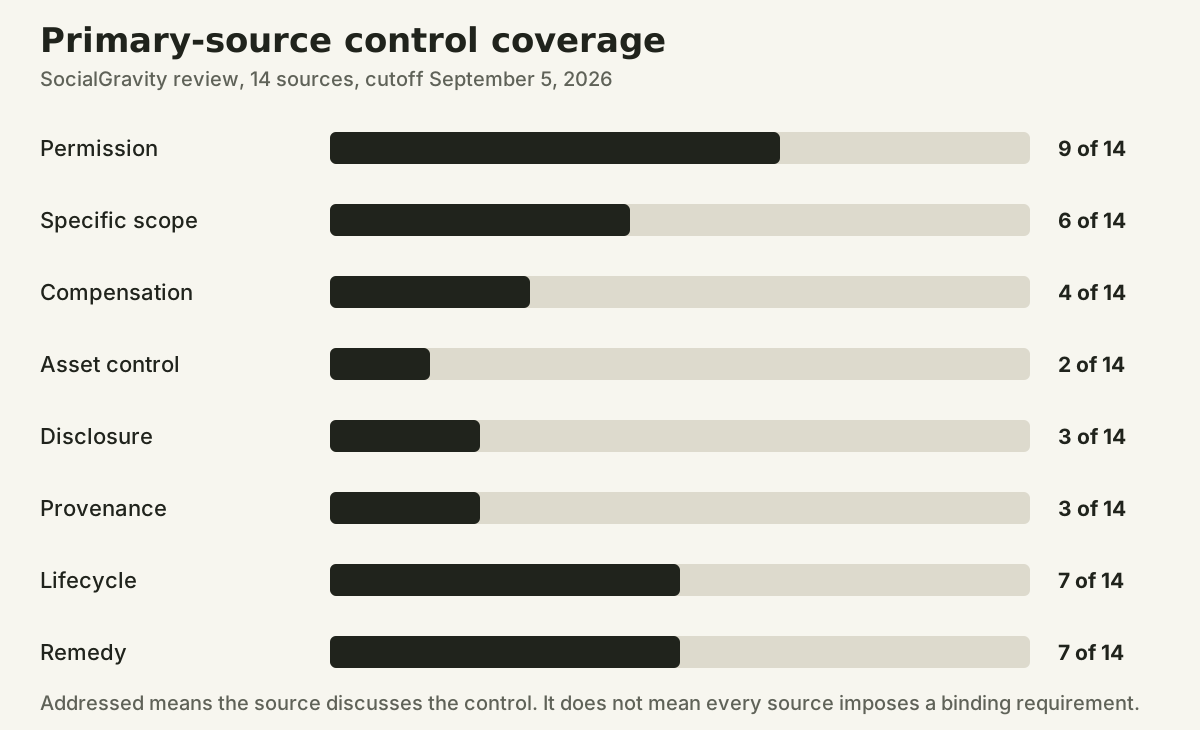
Each source was coded against eight controls. A true value means the source expressly addresses the topic. It does not mean the source imposes a binding requirement, applies worldwide or is equivalent in authority to another source.
| Control | Coding definition | Sources |
|---|---|---|
| Permission | The source addresses authorization, consent, licensing or a right to control use of a person’s voice or visual likeness. | 9 of 14 |
| Specific scope | The source addresses intended-use specificity, contract form, project limits or a requirement for additional approval. | 6 of 14 |
| Compensation | The source addresses payment, wages, residuals, benefit contributions or disclosure of a paid relationship. | 4 of 14 |
| Asset control | The source addresses access, security, storage, transfer or destruction of a replica or source asset. | 2 of 14 |
| Disclosure | The source addresses telling an audience that content is synthetic, manipulated, sponsored or otherwise materially connected. | 3 of 14 |
| Provenance | The source addresses machine-readable origin, history, marking, binding, watermarking, detection or signed content assertions. | 3 of 14 |
| Lifecycle | The source addresses duration, expiry, termination, additional use, credential revocation or treatment after a permission period. | 7 of 14 |
| Remedy | The source addresses unenforceability, liability, removal, a cause of action or a policy proposal intended to close a legal gap. | 7 of 14 |
The dataset keeps enacted law, proposed legislation, government reports and guidance, collective agreements and technical standards in separate fields. A proposal is not reported as law. A collective agreement is not reported as universally applicable. A technical standard is not reported as personal permission.
| Source | Authority class | Status |
|---|---|---|
| Copyright and Artificial Intelligence, Part 1: Digital Replicas U.S. Copyright Office | Government report or guidance | Policy report and recommendations, not enacted law |
| AB 2602: Contracts against public policy, digital replicas California Legislature | Enacted law or regulation | Enacted, applicable to specified new performances fixed on or after January 1, 2025 |
| AB 1836: Use of likeness, digital replica California Legislature | Enacted law or regulation | Enacted |
| ELVIS Act, Public Chapter 588 Tennessee General Assembly | Enacted law or regulation | Enacted, effective July 1, 2024 |
| S.4591: NO FAKES Act of 2026 United States Congress | Proposed legislation | Advanced by the Senate Judiciary Committee by voice vote on June 18, 2026; a September 30 unanimous-consent request was blocked; not enacted as of October 13, 2026 |
| TAKE IT DOWN Act, Public Law 119-12 United States Congress | Enacted law or regulation | Enacted as Public Law 119-12; the covered-platform notice-and-removal requirement took effect May 19, 2026 |
| Regulation (EU) 2024/1689, Article 50 European Union | Enacted law or regulation | Enacted regulation |
| Report on Copyright and Artificial Intelligence UK Government | Government report or guidance | Government report with a separate digital-replicas consultation announced |
| Artificial Intelligence under the 2025 Commercials Contract SAG-AFTRA | Collective agreement | Collective agreement guidance |
| 2026 Theatrical and Television Memorandum of Agreement SAG-AFTRA | Collective agreement | Collective agreement with some phased provisions |
| Interactive Digital Replicas and Consent SAG-AFTRA | Collective agreement | Collective agreement guidance |
| FTC Endorsement Guides: What People Are Asking Federal Trade Commission | Government report or guidance | Federal advertising guidance |
| NIST AI 100-4: Reducing Risks Posed by Synthetic Content National Institute of Standards and Technology | Government report or guidance | Technical report |
| C2PA Content Credentials specification 2.4 Coalition for Content Provenance and Authenticity | Technical standard | Technical specification version 2.4 |
U.S. Copyright Office · United States, federal · Policy report and recommendations, not enacted law
Recommends a federal digital-replica right and says licences should use informed consent, full disclosure of intended uses and limited terms.
California Legislature · California, United States · Enacted, applicable to specified new performances fixed on or after January 1, 2025
Makes a covered contract provision unenforceable for specified new digital-replica performances when intended use is not reasonably specific and the individual lacks the representation described by the statute.
California Legislature · California, United States · Enacted
Adds liability for producing, distributing or making available certain unauthorized digital replicas of deceased personalities in expressive works, subject to listed exceptions.
Tennessee General Assembly · Tennessee, United States · Enacted, effective July 1, 2024
Adds voice, including a readily identifiable simulation, to Tennessee’s protected personal rights and extends liability to specified unauthorized uses and distribution.
United States Congress · United States, federal · Advanced by the Senate Judiciary Committee by voice vote on June 18, 2026; a September 30 unanimous-consent request was blocked; not enacted as of October 13, 2026
Would create a federal right in an individual’s voice and visual likeness, with a notice-and-counter-notice framework and enumerated speech protections. It remains proposed legislation.
United States Congress · United States, federal · Enacted as Public Law 119-12; the covered-platform notice-and-removal requirement took effect May 19, 2026
Creates a narrow federal rule for nonconsensual intimate depictions, including defined digital forgeries, and requires covered platforms to operate a notice-and-removal process. It is not a general commercial likeness-licensing statute.
European Union · European Union · Enacted regulation
Requires certain providers to mark synthetic outputs in a machine-readable and detectable format and certain deployers to disclose deepfake image, audio or video, subject to the regulation’s exceptions.
UK Government · United Kingdom · Government report with a separate digital-replicas consultation announced
Says replicas can imitate a person’s voice or likeness without permission, identifies gaps in existing protection and announces further consultation rather than a completed licensing rule.
SAG-AFTRA · Covered United States commercials work · Collective agreement guidance
Describes consent for creation and use, a separate clear writing, reasonably specific intended use, added consent beyond scope, compensation, access security and storage limits.
SAG-AFTRA · Covered United States television and theatrical work · Collective agreement with some phased provisions
Addresses consent, payment, legitimate-business-need access, security, transfer obligations and use-specific treatment for digital replicas, with some terms phased to later dates.
SAG-AFTRA · Covered United States interactive-media work · Collective agreement guidance
Describes separate written consent, a reasonably specific intended use, per-game compensation and rules allowing performers to suspend consent for generating new material during a strike.
Federal Trade Commission · United States, federal · Federal advertising guidance
Says endorsements must be honest and not misleading and that unexpected material connections affecting evaluation should be disclosed clearly and conspicuously. It does not grant likeness permission.
National Institute of Standards and Technology · United States, technical guidance · Technical report
Reviews provenance, watermarking, labeling, detection, testing and auditing approaches for synthetic content. Those techniques do not establish a person’s permission by themselves.
Coalition for Content Provenance and Authenticity · International technical standard · Technical specification version 2.4
Defines signed, cryptographically bound assertions about an asset’s provenance and adds repository receipts plus current soft-binding and live-video mechanisms. Validation does not decide whether a depicted person consented.
Download JSON · Download CSV · Download SVG chart
This review is intentionally selective, English-language and operational. It does not measure prevalence across all law. Source status can change after the cutoff. A later edition must retain this version, publish a new reviewed-through date, identify added or changed sources and recompute every count from the released data.
Read the reportInspect the evidence chain
Method transparency makes the counts reproducible. It does not turn this research into legal advice.
Only primary sources from legislatures, government bodies, unions and technical standards organizations were included, and each had to directly address a control relevant to AI digital replicas.
It means the source expressly discusses the coded control. It does not mean the source creates a binding universal requirement.
They reveal different parts of the operating environment. The authority_type and status fields keep their legal weight separate.
Download the JSON or CSV, count true values for each control and verify each row against the linked primary source.